Richard Cassidy - Our Story
Richard Cassidy shares Indigenous wisdom through storytelling, navigating traditional and Western knowledge systems while empowering future generations to connect with country and culture.
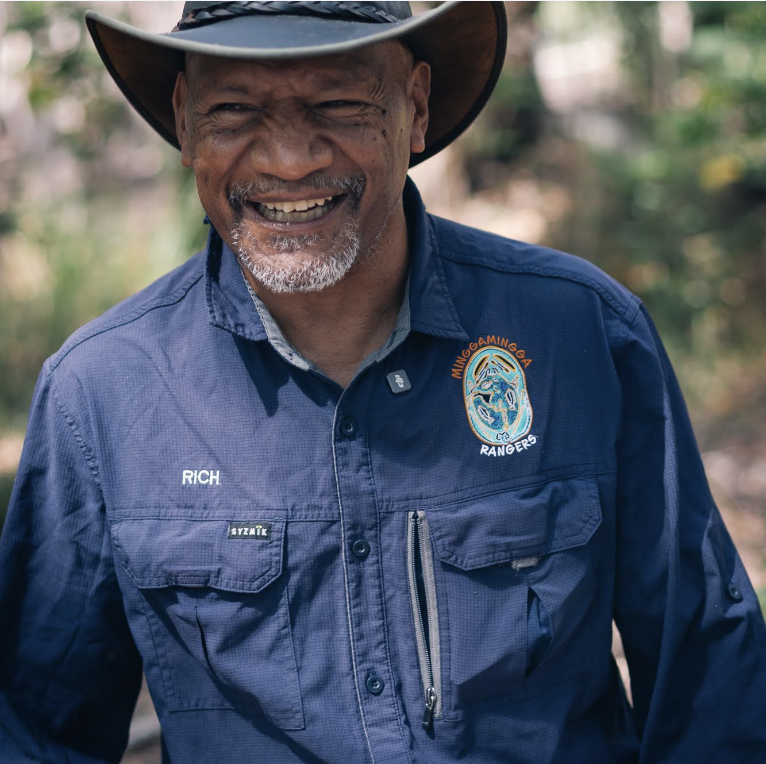
Richard Cassidy: Bridging Two Worlds Through Story
Richard Cassidy is a First Nations man whose journey embodies the bridging of cultural knowledge with modern practice. Connected deeply to his grandmother's country on Manbarra land at Palm Island, he carries forward a profound cultural obligation passed down from his grandfather.
Connection to Country
"This is my grandmother's country. And she's a mum of a woman. We married a Nahuatl man," Richard explains, situating himself within his lineage. "Grandfather would say to me, you know, Richie, you're always gonna look after your grandmother's country."
For Richard, country isn't just land—it’s identity and purpose:
"Country helps me be, and helps me be me, and helps me understand who I am. And it's out of that, from that base of where I land, that I can work out what my doing is going to be."
Creating "Our Story"
Richard believes deeply in the power of shared narratives. His approach centres on respectful listening and the merging of different perspectives:
"There are people who are wanting to come into this space and would love to be able to engage with me or my people. And I say to folk, well, tell me your story and I'll tell you my story and then we'll try and figure out how my story and your story can become an our story."
This philosophy guides how he builds relationships across cultural divides:
"It's a very, I think, it's an easier vehicle to be able to engage with conversation as human beings, rather than as first people, second people, or whatever construct you want to use... Story is a good vehicle to be able to work on, because everyone understands that story, that concept of story."
Navigating Two Worlds
Richard speaks often about navigating between traditional knowledge and modern systems:
"I navigate those two worlds intuitively inside almost all day every day. So I've got this dominant culture side and I've got this cultural side. And one informs each other."
He uses the metaphor of a spear with two edges—the L-O-R-E (traditional law) and the L-A-W (Western legal systems):
"When we make this spear, this one that enables us to cut a path into this landscape, we actually need two sides of the story, the L-O-R-E and the L-A-W."
The Power of Listening Together
For Richard, the creation of "our story" depends on deep, respectful listening:
"That story is dependent though in its practice for entities to hold each other's story in balance or gently, if that makes any sense, and respectful conversations. It's not to say, I am the one who knows and you need to jump through. It's about, hey I've got something that I'm going to offer you and you can choose to take that story or you can choose not to take that story."
He emphasises that listening must go beyond mere hearing:
"It's about understanding the story of the other in a way that you might not have that answer, but you go, ah, I can see you, see me see you. And it's about trying to see one in someone, but not, and to hold that other gently. And conversely, if that's switched the other way around, then I think you've got a powerful space for conversation."
Leading Through Cultural Practice
As leader of the Manbarra Operations, Richard applies these cultural frameworks to modern organisational development:
"As we then build organisations, we've got a young organisation, Manbarra Operations, we then can figure out... we're hunting for particular fish. So we want the Goggin who understands how to do finance, the Goggin who understands business, and the one who helps us shape policies and procedures."
He teaches his team to navigate complexity through cultural understanding:
"I say to my cousin brothers or who I'm talking to or my colleagues or the workers under me, we've got to navigate these two wells but for you to understand these two wells you've got to navigate these two worlds. But for you to understand these two worlds, you've got to know your own world."
The Pebble Philosophy
Richard shares the story of the pebble—a teaching about minding one's impact when entering another's country:
"Don't come to someone else's country as a rock or a boulder, but as a pebble, so that your footprint is small. But when you leave, that person says, 'Oh, that one came, your presence is great, and there's a heart. He came and didn't make a ripple. So he's welcome anytime.'"
When asked about his own legacy, he embodies this philosophy:
"I want to be the smallest pebble I can be, the sharpest stone, the one that has the least impact... my footprint would be that no one knew that I was here in the first place and that'd be pretty cool."
Future Vision
For the land where he works, Richard envisions restoration and regeneration:
"We're planning to minimise that boulder and the impact of that rock and restore this country... the country is restoring itself and regenerating itself."
His leadership focuses on empowering the next generation:
"The goal will be that in this space, some of our young people from Palm will be inspired to imagine what this place might look like... I'll hopefully accord and release some of those Banams to be Goggins of this place and they can work out what that might look like."
Richard ultimately sees his role as that of a navigator—helping others find their own path while respecting the wisdom of country:
"The answers are in country and you just got to look around and find that... part of the role is, for me in this space, is as a navigator, is being a guide... it's about having respectful conversations and understanding the story of the other."